Older houses often contain materials installed long before the health risks of asbestos were widely understood. The material was valued for its strength, insulation, and resistance to heat, so it appeared in many ordinary building products. It may be harmless when sealed and left alone, but renovation can change that situation quickly. Knowing where it may be present helps a homeowner avoid turning a routine repair into an exposure event.
Common asbestos-containing building materials
Asbestos was incorporated into products used throughout a house, including some pipe insulation, attic insulation, cement siding, roofing materials, vinyl floor tiles, flooring adhesives, textured coatings, and joint compounds. It could also appear in older furnace components, boiler insulation, and electrical or heat-resistant materials. These products do not all look alike, and some resemble ordinary plaster, cardboard, fabric, or cement.
The material is not limited to one room or one type of construction. A basement, garage, utility area, kitchen, bathroom, and living space may each contain different suspect materials. A home renovation asbestos guide can help explain common locations and planning questions, but general information cannot identify a particular product in a particular house.
Areas most likely to be disturbed during repairs
Repair work tends to focus on the very places where older materials may be installed. Replacing a floor can disturb tiles or adhesive; opening a wall can affect insulation or joint compound; and repairing a roof, siding, or ceiling can break older exterior or finishing products. Plumbing and electrical work may also require access through walls, ceilings, or insulated service spaces.
Damage is not always dramatic. A small hole for a light fixture, a few removed tiles, or a scraped section of old coating can disturb a material that was previously intact. The risk depends on the material, its condition, and the work being done, which is why assumptions based only on the size of the repair are unreliable.
Why asbestos can remain hidden beneath newer finishes
Later owners may cover older materials with paint, paneling, carpet, laminate, drywall, or a newer layer of flooring. Those finishes can make a room appear recently updated while leaving the original material underneath. Removing the newer surface may expose the older layer and create dust before anyone realizes what has been uncovered.
Layers can also complicate inspection. A homeowner may see only the top finish and have no way to know what lies below it without disturbing the assembly. For that reason, pulling back a corner “just to check” is not a safe identification method. The safest approach is to treat uncertain hidden materials as suspect until qualified professionals assess them.
When a building’s age increases the likelihood of asbestos
The age of a building is a useful warning factor, not proof that asbestos is present. Older homes are more likely to contain products made during periods when asbestos was commonly used, and renovations may have added materials from different decades. A house built before the early 1990s deserves particular caution when walls, floors, ceilings, insulation, siding, or mechanical systems will be disturbed.
Records can help establish when work was performed, but they are often incomplete, especially in houses that have changed ownership several times. Even a newer addition may connect to older materials in the original structure. Before work begins, the building’s history should be considered alongside the planned disturbance rather than treated as a substitute for testing.
How DIY repairs can release asbestos fibers
Asbestos becomes a serious concern when a material containing it is damaged or disturbed. DIY work can create that disturbance through ordinary tools and familiar repair techniques. Once fibers become airborne, they may move beyond the immediate work surface and settle on clothing, tools, furniture, or nearby floors. A project that begins as maintenance can therefore become a contamination problem.
Cutting, drilling, sanding, and scraping
Power tools and hand tools can break the binding that holds asbestos fibers inside a product. Cutting a board, drilling through a panel, sanding a coating, or scraping adhesive may produce dust and fragments that are difficult to control. Heat, vibration, and friction can all make the work more disruptive than it appears from across the room.
Wet methods and protective procedures used by trained professionals are not a license for an untrained person to proceed. The central problem is that the worker may not know the material’s composition, how far dust has traveled, or how to contain and dispose of the waste. Stopping before the first cut is safer than trying to manage an unknown material after it has been disturbed.
Demolition and removal of damaged materials
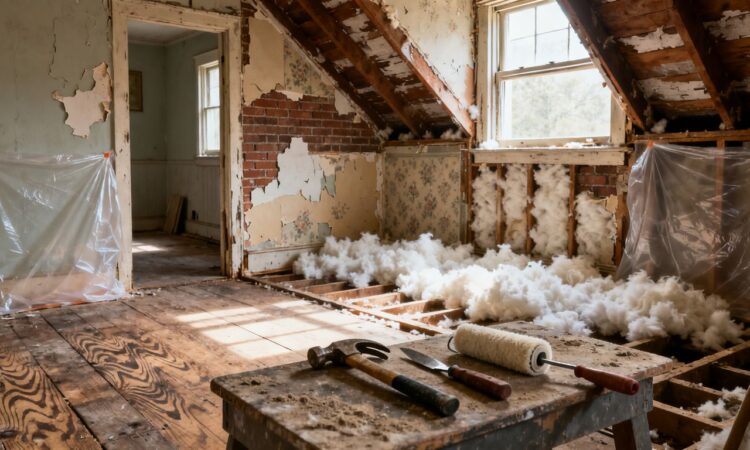
Demolition is especially concerning because it often involves force rather than careful removal. Pulling out old insulation, breaking flooring, tearing down a ceiling, or removing damaged siding can fracture material into many pieces. A damaged product may already release fibers more readily, and demolition can spread those fibers through air movement and foot traffic.
Older-house renovation guidance commonly warns about insulation, siding, and floor tiles for this reason. The practical lesson is straightforward: demolition should not begin simply because a material looks old or disposable. A DIY renovation asbestos overview offers broader background on renovation hazards, but a property-specific evaluation remains necessary before removal.
Dry cleanup methods that spread contamination
Sweeping, brushing, shaking out clothing, or using an ordinary household vacuum can redistribute settled dust. Those methods may lift fine particles back into the air or move debris into clean rooms. Wet wiping and controlled professional cleanup follow different procedures, but an individual who suspects asbestos should avoid experimenting with either removal or cleanup.
A few basic mistakes can expand the affected area quickly. Common examples include:
- Carrying dusty tools or shoes into another room.
- Placing contaminated clothing in a household laundry basket.
- Using a broom or standard vacuum on visible debris.
- Opening windows or using fans in ways that move dust through the house.
These actions can make later assessment more difficult and may expose other occupants. After suspected disturbance, the priority is to stop movement through the area and obtain advice rather than trying to make the room look clean.
Why seemingly minor repairs can create airborne fibers
The amount of visible debris does not reliably indicate the amount of airborne contamination. A small repair can involve a concentrated material in an enclosed space, and fibers may be too small to see while the work is underway. Dust can also enter cracks, ventilation pathways, and porous furnishings that were never part of the original repair plan.
That is why a short task should not be judged solely by its duration. The short-term exposure information explains why duration, concentration, and the circumstances of an encounter all matter. Even when a brief incident does not lead to illness, preventing a repeat exposure is a sensible and important goal.
Understanding DIY asbestos exposure risks
The central DIY asbestos exposure risks come from inhaling fibers released during disturbance. Exposure is not defined by seeing a cloud of dust or feeling irritation in the throat. A person may leave the work area unaware that fibers have entered the breathing zone or traveled on clothing. Understanding the pathway helps explain why caution is needed even when the project seems controlled.
Inhalation as the primary exposure pathway
Inhalation occurs when airborne fibers enter the lungs during cutting, demolition, cleanup, or movement through a contaminated area. Some fibers may be swallowed after being cleared from the airways, but breathing contaminated air is the main concern during home repair. The worker, nearby occupants, and anyone who later cleans the area may all be affected by the same release.
Respiratory discomfort is not a reliable exposure detector. A person can inhale fibers without immediate pain, coughing, or a visible reaction. Because the body may not provide a prompt warning, the work practice and condition of the material matter more than how the worker feels in the moment.
Why airborne fibers are difficult to see
Asbestos fibers are microscopic and can mix with ordinary household dust. Light may reveal larger fragments, but it cannot show whether an invisible cloud contains fibers or where those fibers have settled. Air currents from heating systems, fans, doors, and normal movement can carry particles away from the original task.
This makes visual reassurance particularly weak. A room that looks clear after a repair may still require professional evaluation if suspect material was damaged. The absence of visible dust is not evidence that no exposure occurred, and the presence of dust does not reveal its composition.
Short-term exposure versus repeated exposure
A single brief incident does not allow anyone to calculate an individual’s future health outcome. Risk can vary with the type and condition of the material, the amount of disturbance, ventilation, duration, and whether protection or containment was used. Repeated repair projects can create cumulative opportunities for exposure, especially when a homeowner continues working in an older house without confirming materials.
The health discussion around brief encounters is nuanced: short-term exposure is generally less concerning than sustained, high-concentration exposure, but no one should treat that distinction as permission to continue. Short-term asbestos health risks provide context for why repeated brief exposures deserve attention. The practical response remains prevention, documentation, and professional advice rather than speculation.
How fibers can spread to other rooms and clothing
Dust can move when a person walks, handles tools, removes protective clothing, or opens a door. Clothing and shoes may carry residue to hallways, vehicles, bedrooms, or laundry areas. Family members and pets can encounter contaminated dust without ever entering the original work zone.
Cross-contamination is especially easy when a repair takes place near an air return, stairway, or shared storage area. Work materials should not be transported through the home after suspected disturbance. Until professionals provide direction, occupants should limit access and avoid touching surfaces or debris unnecessarily.
Health effects associated with asbestos exposure
Asbestos-related disease usually does not appear immediately after a repair. Fibers can remain in the body and contribute to illness after a long latency period, sometimes decades. This delay can make it difficult to connect a later diagnosis with an old renovation, which is one reason exposure history should be recorded when an incident occurs.
Diseases linked to inhaled asbestos fibers
Inhaled asbestos fibers have been associated with serious diseases, including asbestosis, lung cancer, and mesothelioma. They may also contribute to other cancers and changes affecting the lining around the lungs. These conditions are not inevitable after every exposure, but they are serious enough that avoidable disturbance should be prevented.
Health risk is not determined by a single visible sign or by whether a material looked dusty. It involves the exposure circumstances over a person’s lifetime. Anyone worried about a past event should discuss the situation with a qualified medical professional rather than trying to diagnose an illness from general information.
Why symptoms may take decades to appear
Asbestos-related conditions often have a long latency period. A person may feel well for years after exposure while disease processes develop slowly. That gap can create false reassurance and may cause an older home repair to be forgotten.
The delay also means that immediate medical testing generally cannot confirm whether a person inhaled a particular amount of asbestos during one incident. Medical care is still appropriate for ongoing or concerning symptoms, but the absence of an immediate test result should not be confused with proof that exposure did not happen.
Factors that can influence health risks
Potential risk is shaped by several circumstances, including the concentration of fibers, the duration and frequency of exposure, the condition of the material, and the effectiveness of containment. Personal factors and other inhaled hazards may also matter. Smoking, for example, is an important health consideration when discussing asbestos-related lung disease with a clinician.
These factors cannot be used by a homeowner to produce a dependable personal risk score. They are useful for giving professionals a clearer account of what happened. Notes about the material, task, room, duration, visible dust, people present, and cleanup actions can make later advice more informed.
Why the absence of immediate symptoms is not reassuring
Most immediate sensations after dusty work, such as a scratchy throat or cough, are not specific to asbestos exposure. Conversely, a person may have no symptoms at all after inhaling fibers. Neither response confirms or rules out exposure.
The sensible response is therefore based on the event, not on the body’s immediate reaction. Work should stop if suspect material was disturbed, and the area should be managed carefully. A guide to short-term exposure can provide general context, while a healthcare professional can address individual medical concerns.
Warning signs that a repair may involve asbestos
No single visual clue can establish that a building product contains asbestos. Warning signs instead arise from the combination of a home’s age, the material’s location, its condition, and the proposed work. When several of those factors appear together, delaying the repair is wiser than relying on a guess.
Materials that look suspicious or are difficult to identify
Materials deserve caution when they are old, layered, fibrous, brittle, unusually dense, or unlike products commonly sold today. However, asbestos-containing products can resemble many ordinary materials, and appearance varies with age and wear. A sample that looks harmless may still require laboratory analysis.
Uncertainty itself is a reason to pause. Searching for photographs or comparing a fragment with an online image may help explain why a product is suspect, but it cannot confirm its composition. No homeowner should break, scrape, or remove more material to obtain a better look.
Damaged, friable, or deteriorating materials
A friable material can crumble or release particles with relatively little pressure, making its condition especially relevant. Water damage, vibration, pests, aging, and previous repairs may weaken a product. Peeling, crumbling, fraying, or broken surfaces should not be handled casually.
Even a nonfriable product can release fibers if it is cut, sanded, drilled, or smashed. The distinction is therefore not a simple safe-versus-dangerous label. It helps professionals decide how to assess and control the material, while the homeowner’s safest choice is to avoid disturbing either type when asbestos is possible.
Renovation plans that involve walls, floors, or ceilings
Projects involving walls, floors, and ceilings deserve advance review because they often affect multiple layers of construction. Installing recessed lighting, replacing flooring, opening a chase, removing textured coating, or moving a partition can disturb concealed materials. The same applies to work around boilers, ducts, pipes, and older electrical systems.
A project plan should identify every surface that will be cut, removed, drilled, or scraped. If the plan changes after work begins, the new task should receive the same level of caution. A renovation should not proceed on the assumption that only the visible finish matters.
Why visual inspection alone cannot confirm asbestos
Only appropriate professional sampling and analysis can establish whether a suspect material contains asbestos. Visual inspection can identify areas that need attention, but it cannot reliably distinguish asbestos from similar-looking fibers, binders, or fillers. Sampling itself can disturb the material, so it should be performed by someone trained to do it safely.
That limitation is easy to overlook when a homeowner is trying to keep a project moving. Yet a confident guess can lead to unnecessary exposure, incorrect disposal, or contamination of the rest of the house. Treating uncertain material as suspect until qualified advice is obtained is the more responsible decision.
Safer steps before starting work in an old house
Planning is the best opportunity to prevent a DIY asbestos incident. Before a tool is used, the homeowner should consider the building’s age, renovation history, materials that may be affected, and the people who could be nearby. The goal is not to diagnose asbestos personally, but to avoid disturbing it unknowingly.
Pause work when suspect materials are discovered
If an unexpected layer, insulation product, tile, coating, or fragment appears suspicious, work should stop immediately. The material should be left in place, and people should leave the immediate area without tracking dust elsewhere. Tools and debris should remain where they are until a professional explains the next step.
A pause may feel inconvenient, especially when a room has already been opened. It is still far less disruptive than continuing, spreading contamination, and having to investigate a larger area. The work plan can be revised once the material has been assessed.
Arranging professional asbestos inspection and testing
An asbestos inspector can evaluate the material, determine whether sampling is appropriate, and explain what restrictions apply to the project. Testing should be arranged before demolition or removal, not after dust has spread. The inspector’s report may also help define which areas can remain undisturbed and which require controlled work.
Local rules can affect notification, sampling, disposal, and renovation procedures. A homeowner should seek information from the relevant state or local authorities and use qualified professionals familiar with those requirements. General online guidance cannot replace a site-specific inspection.
Choosing licensed asbestos abatement professionals
When asbestos-containing material must be removed, enclosed, repaired, or otherwise managed, the work should be assigned to properly licensed or qualified asbestos professionals as required by local law. Such professionals have procedures for containment, protective equipment, waste handling, and clearance. Their role is different from that of an ordinary handyman who has not been trained for asbestos work.
The homeowner should verify credentials, ask what the proposed scope includes, and obtain written information about containment and disposal. In some jurisdictions, requirements vary by material type and project size. If a contractor dismisses the concern or proposes ordinary demolition methods for suspect material, the project deserves a second review before proceeding.
Preventing unnecessary disturbance and cross-contamination
Until the material is assessed, access should be limited and doors should remain closed where practical. Household members should stay away from the work area, and clothing, tools, and debris should not be carried through clean parts of the house. Heating or cooling systems that could move dust may require professional consideration.
A simple prevention plan can keep uncertainty from becoming a wider household problem. It may include documenting the location without touching the material, notifying everyone in the home, and postponing adjacent work. Careful restraint at this stage protects both the occupants and the professionals who may later evaluate the area.
What to do after suspected asbestos exposure
A suspected exposure calls for calm, deliberate action rather than frantic cleaning. The immediate priorities are to reduce further movement, prevent additional disturbance, and obtain qualified advice. A single incident cannot be interpreted accurately without knowing what material was involved and how it was handled.
Leaving the affected area safely
People should leave the area by the shortest practical route and avoid walking through visible debris. Doors can be closed if doing so does not require touching contaminated surfaces, while unnecessary movement and airflow should be minimized. Others in the household should be kept away until professionals provide direction.
Shoes, clothing, tools, and personal items that may have contacted dust should not be casually carried into clean rooms. Individuals should avoid shaking clothing or brushing particles from their bodies. Further instructions should come from asbestos professionals or local public health authorities familiar with the situation.
Avoiding sweeping, vacuuming, or handling debris
Ordinary sweeping and household vacuuming can spread fine dust rather than remove it safely. Debris should not be picked up, bagged, sorted, or transported by an untrained homeowner. Wetting, wiping, or applying a household product without professional direction may also alter the evidence and complicate proper cleanup.
The safest immediate choice is to leave the debris undisturbed and describe its location when seeking help. If the material has entered several rooms, that information should be reported clearly. Prompt, accurate details are more useful than an improvised cleanup that hides how far contamination may have traveled.
Reporting the incident to the appropriate professionals
The incident should be reported to a qualified asbestos inspector, licensed abatement contractor, or the relevant local or state environmental or public health agency. The appropriate contact depends on the jurisdiction and the scale of the work. A professional can advise on isolation, testing, cleanup, disposal, and whether other occupants should leave temporarily.
Useful information includes the home’s age, the suspected material, the task being performed, the time spent working, visible dust or damage, people present, and any cleanup already attempted. Photographs may help if taken without reentering or touching the affected area. Clear reporting helps professionals respond to the actual circumstances rather than an incomplete description.
When to seek medical guidance about potential exposure
Medical guidance is appropriate when a person is worried about a suspected exposure, has respiratory symptoms, or has a history of significant or repeated contact with asbestos. A clinician can document the concern, review smoking and occupational history, and decide whether any evaluation is appropriate. Emergency symptoms such as severe breathing difficulty require urgent medical care.
There is usually no immediate symptom that proves an asbestos-related disease, and routine testing cannot simply measure a past household exposure. That does not mean the concern should be ignored. Recording the event and discussing it with a healthcare professional gives the person a sensible record for future care without creating unnecessary alarm.