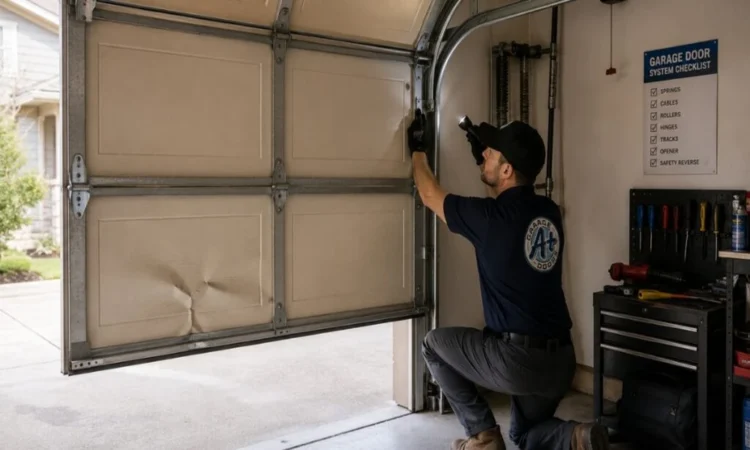
A typical family opens and closes its garage door somewhere around 1,500 times a year. No other part of the house moves that much weight that often, so it is no surprise that the door eventually needs work. What surprises people is how hard the next decision feels. One technician quotes a spring replacement, a neighbor says the whole door is due, and the homeowner is left wondering which advice actually fits a door they have lived with for a decade or more.
The honest answer depends less on the broken part and more on where the door sits in its life. A snapped spring on a three-year-old door is a routine fix. The same spring on a door that is twenty-five years old, rusting at the bottom section and paired with an opener that predates modern safety rules, is a different conversation.
That conversation happens all the time around Franklin County. Doordummies.com, the site of a family-run company that handles garage doors repair in Franklinton and across towns like Wake Forest, Knightdale and Zebulon, describes its approach as clear quotes before any work and no pressure to buy more than the door needs. That is the mindset worth bringing to your own decision, whoever you call.
The First Few Years
A door in its first five or so years almost always deserves repair. Problems this early tend to come from installation details or outside events rather than wear. A car backing into a bottom panel, a cable that was tensioned unevenly, or a photo eye knocked out of line by a recycling bin are all fixable without questioning the door itself.
This is also the window when manufacturer warranties usually still apply to sections and hardware. Before paying for anything, it is worth digging out the paperwork, since a dented panel or a failed opener board may be covered.
The Long Middle Stretch
Between roughly five and fifteen years, most repairs are about parts that are simply designed to wear out. Standard torsion springs are commonly rated around 10,000 cycles, which a busy household can use up in seven to ten years. Rollers flatten, cables fray at the bottom brackets, and opener gears lose teeth.
None of these failures says much about the door’s overall condition. Replacing springs in matched pairs, swapping worn rollers for sealed nylon ones and tightening the hardware can give a door in this stage many more good years. The repair bill here is usually a small fraction of what a new installed door costs, which makes the math straightforward.
The exception is physical damage to the sections. A dent can often be lived with, but a panel that has buckled or cracked changes how the door carries its own weight. Replacing just one section is possible when the manufacturer still makes that model and color, though matching a faded finish can be tricky.
When the Door Has Real Mileage
Past fifteen years, and especially past twenty, the question shifts from “can this be fixed” to “should it be.” Several signs tend to tip the balance toward replacement.
- Rust that has eaten through the bottom section or the struts rather than sitting on the surface
- Wood that is soft, split or splintering around hinges and brackets
- Replacement panels that are no longer manufactured for that design
- A door with no insulation in a garage that now doubles as a gym, workshop or laundry space
- Repairs on different parts arriving every few months instead of every few years
When two or three of these show up together, money spent on springs and cables starts to feel like patching an old roof one shingle at a time. The door works, but it keeps asking for more.
The Opener Is a Separate Decision
People often treat the door and opener as one unit, but they age on different clocks. Openers commonly last ten to fifteen years, while a well kept steel door can last much longer.
The opener’s age matters for safety, not only reliability. Federal rules have required openers sold in the United States since the early 1990s to include entrapment protection such as photo eyes near the floor, and the reversing standards have been tightened since then. An opener installed before that era, or one whose sensors have been disconnected or bypassed, is worth replacing even if the door itself is healthy. Newer belt drive units are also far less noisy, and many now include battery backup and phone app control as standard.
Checking the Door Before You Call
A short inspection helps you describe the problem clearly and keeps you from being talked into work you do not need. The Door and Access Systems Manufacturers Association has a simple guide for checking a sectional garage door for damage that walks through it in order.
With the door closed, look over the tracks for loose fasteners, the rollers for proper seating, the hinges and brackets for tightness, and every section for cracks, dents or buckling. If anything looks wrong at this stage, stop there. If it all looks fine, pull the red release handle and lift the door by hand. It should move smoothly, without binding or swaying, and stay open on its own when raised.
What you should not do is touch the springs, cables or bottom brackets. They hold extreme tension, and adjusting them without proper tools is one of the most common causes of serious garage door injuries.
Reading the Estimate
A fair repair estimate names the specific parts being replaced and why. For springs, it should state whether both are being changed and what cycle rating the new ones carry, since a higher rated spring costs a little more but lasts noticeably longer. For an off-track door, it should explain whether the track, rollers or cables caused the problem, because fixing only the visible symptom can bring the technician back in a month.
If the estimate pushes a full replacement, ask what specifically rules out repair. A good technician will point to the rusted section, the discontinued panel or the outdated opener rather than speaking in general terms about age.
Thinking Beyond the Repair Bill
A new door is one of the few home projects that tends to recover a large share of its cost at resale, largely because the garage takes up so much of the front of many houses. Insulated steel doors also help attached garages stay closer to indoor temperatures through humid Carolina summers and cold snaps in winter.
Still, none of that makes replacement the automatic choice. A sound door with a broken spring is simply a sound door waiting for a spring. The goal is to spend money where it buys real years of use, and an honest look at the door’s age, its sections and its opener usually makes that choice clearer than any sales pitch could.