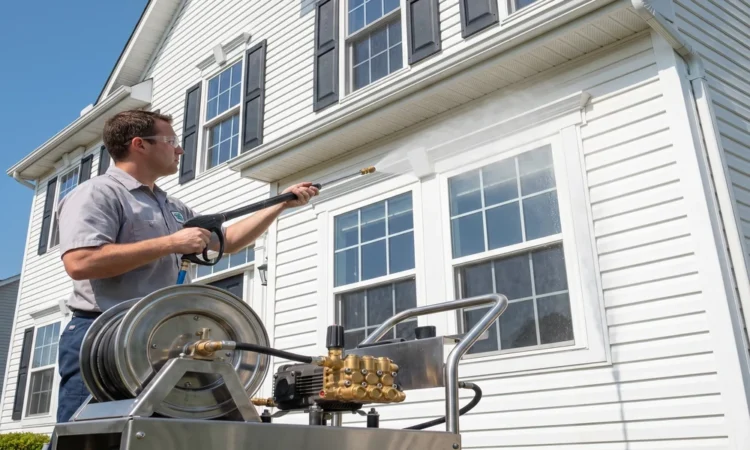
Salt, heat and humidity work on a coastal house every single day. Along the Southeast Florida shoreline, freshly painted stucco can grow a green film within one rainy season, and the shaded north slope of a roof often shows dark streaks long before the shingles are worn out. Cleaning a home exterior without damaging it in this climate is less about how hard you spray and more about matching the method to the surface, because most of what you see is living growth anchored in pores, seams and granules rather than loose dirt sitting on top.
That difference shapes every decision a homeowner makes. High pressure removes visible grime quickly, yet it can etch, dent or force water into places that were never built to get wet. Low-pressure soft washing uses cleaning solutions to kill algae, mold and mildew at the root, so it may look slower on the day but usually keeps surfaces clean for much longer. Water use, drying time and how fast growth returns all shift depending on which approach you pick, and they shift differently on siding, roofing, gutters and glass.
For homeowners who would rather hand the whole exterior to one licensed and insured crew, Soft Touch Power Wash serves properties across Southeast Florida with low-pressure equipment built around soft washing. Its House and Property Washing service treats stucco, vinyl and painted trim with the right solution and a gentle rinse instead of a turbo nozzle, so paint and seams stay intact. Roof and Gutter Cleaning follows the same thinking, lifting algae from shingles and tile while clearing the debris that keeps gutters holding water against the fascia. Window cleaning and commercial surface work are also on offer, and the simplest next step is to request a quote for your property online.
Four Forces Pulling Against Each Other
Every exterior cleaning job balances the same four considerations. Cleaning power sits on one side, and surface damage sits on the other. Water use matters because more volume means more runoff and more moisture pushed into building materials. Drying time matters because, in air that rarely drops below 70 percent humidity, a wall that stays damp for days becomes a fresh home for spores. Longevity ties them together, since a method that looks great today but leaves roots behind will have you paying again in a few months.
| Surface | Gentle method | High-pressure risk | How long results last |
|---|---|---|---|
| Vinyl siding | Soft wash solution, low-pressure rinse | Water forced behind lap seams, warped or cracked panels | Roughly 12 to 18 months |
| Stucco and painted block | Soft wash with surfactant, top-down rinse | Chipped paint, widened hairline cracks, deep saturation | Roughly 12 to 18 months |
| Asphalt shingle roof | Low-pressure chemical application, no scrubbing | Stripped granules, voided warranty, lifted tabs | Roughly 12 to 24 months, longer with zinc strips |
| Concrete or clay tile roof | Soft wash, gentle rinse from the ground or eave | Eroded color coat, water driven under tiles | Roughly 18 to 24 months |
| Gutters | Hand clearing, downspout flush, surfactant on exterior | Dented aluminum, loosened hangers, water behind drip edge | Interior 3 to 6 months, exterior about a year |
| Windows | Purified water and soft brush | Failed insulated glass seals, torn screens | Roughly 2 to 3 months on ocean-facing glass |
Siding Takes the Most Abuse From the Wrong Nozzle
A consumer pressure washer commonly runs between 1,300 and 2,800 psi, while a soft wash system delivers its solution at a few hundred psi or less. That gap is the whole story on siding. Vinyl panels overlap like shingles to shed rain falling downward, so a blast aimed upward pushes water behind the seams where it sits against sheathing. Stucco behaves differently but suffers just as much. It absorbs water like a sponge, and a high-pressure pass drives moisture deep into the hairline cracks that coastal homes almost always have.
Drying time is where the methods split hardest. A soft-washed stucco wall is wet on the surface and dry within hours, while a pressure-saturated wall can stay damp inside for days in humid weather. Fiber cement holds up to force better than vinyl, yet its painted finish still chips at the edges when the tip gets too close.
Roofs Reward Patience Over Force
The dark streaks spreading across Florida roofs are often caused by Gloeocapsa magma, an airborne cyanobacterium that thrives in warm, humid conditions. Although the discoloration may resemble dirt or mold, removing it requires more care than simply increasing water pressure. According to the Asphalt Roofing Manufacturers Association’s official roof cleaning guidelines, pressure washers, brushes and brooms should never be used to remove algae from asphalt shingles. These methods can strip away protective granules, leaving the roofing material more vulnerable to ultraviolet exposure and premature deterioration. Instead, manufacturers recommend approved cleaning solutions applied gently and rinsed with low-pressure water.
Tile roofs present different challenges. Concrete tiles may lose surface color or texture under aggressive cleaning, while clay tiles can crack when workers walk across unsupported areas. The Tile Roofing Industry Alliance’s roof maintenance guidelines emphasize minimizing foot traffic and using trained professionals to prevent unnecessary damage. A professionally applied soft wash can reduce abrasive cleaning and limit the need to walk across fragile tiles. However, cleaning methods must match the tile manufacturer’s recommendations, and water should never be directed upward beneath overlapping tiles. Properly selected cleaning solutions can treat algae and other organic growth rather than merely removing visible surface stains, although Florida’s humid conditions mean regrowth remains possible.
Gutters Fail From the Inside Out
Gutters are mostly a debris problem. Leaves, palm fronds and roof grit hold water that rots fascia boards and breeds mosquitoes, so the real work is hand clearing and flushing downspouts. Pressure seems faster, yet seamless aluminum dents easily, hangers can pop loose, and a jet aimed into the trough often sends water behind the drip edge.
The outer face is a separate issue. Gray vertical lines on white gutters are oxidation marks that pressure alone rarely removes, while a dedicated surfactant clears them with light hand work. Runoff matters here too, since downspouts concentrate everything washed off the roof. Many Florida cities bar wash water from storm drains, so crews pre-wet landscaping and steer discharge onto lawns where soil can filter it.
Glass Needs Pure Water, Not Force
Windows near the ocean collect a salt film that turns hazy within weeks, and well water used for rinsing leaves mineral spots once it dries. Purified water applied with a soft brush on a pole dries clear because nothing is left behind to spot. High pressure adds risk without adding shine. It can push water past the seals of insulated glass units, which later show up as fogging between panes, and it tears window screens in a single pass.
Siding and roof solutions can also spot glass and dull aluminum frames if overspray is left to dry in the sun. Careful crews rinse windows during the house wash and finish them last.
Reading the Trade-offs for Your Own House
Order of work matters as much as method. Cleaning starts at the roof, moves to gutters, then siding, and ends at the windows, so dirty runoff never lands on a finished surface. Early morning works best because cleaning solution evaporates too fast in midday heat to do its job. On a coastal home, the gentle method that takes a little more patience almost always comes out ahead, since it protects the materials, uses water more carefully and keeps growth away long enough to make the cleaning worth paying for.